
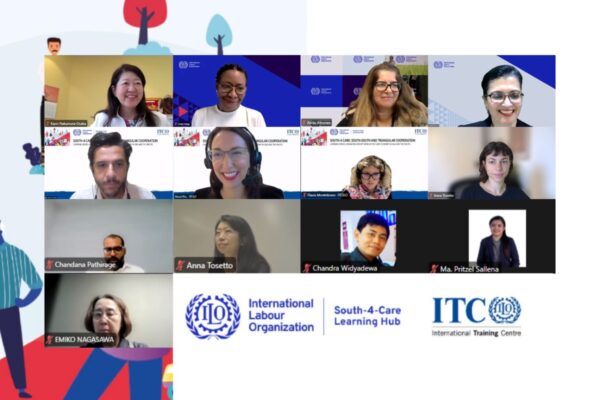
GENEVA/BANGKOK, 7 October 2026 – The International Labour Organization (ILO) has launched the South-4-Care South-South and Triangular Cooperation Learning Series for Asia and the Pacific, bringing together governments, employers’ and workers’ organizations and development partners to exchange practical solutions for advancing decent work in the care economy.
Turning knowledge into action for the care economy in Asia and the Pacific throguh South-South Cooperation
The ILO has launched the South-4-Care South-South and Triangular Cooperation Learning Series for Asia and the Pacific, creating a new space for countries, governments, employers’ and workers’ organizations and partners to learn from one another and turn experience into practical cooperation.
Opening the inaugural session, Kaori Nakamura-Osaka, ILO Regional Director for Asia and the Pacific, situated the care economy firmly within the region’s priorities, welcoming a process designed around the diverse realities, experiences and solutions emerging across Asia and the Pacific. The Learning Series is intended not only to share knowledge, but to identify care-economy challenges and opportunities where South-South exchange can make a practical contribution.
The moderation was held by Deepa Bharathi, Senior Specialist for Gender Equality, Non-Discrimination & Inclusion in ILO Regional Office for Asia and the Pacific.
Building on this regional perspective, Anita Amorim, Head of the ILO’s Emerging, Special and South-South Partnerships Unit, emphasized the importance of moving from exchange to implementation:
“South-South cooperation should not be understood simply as countries telling one another what they have done. It is countries working together on what they will do next.”
ILO highlighted how South-South and triangular cooperation can help countries progress from knowledge sharing, to institutional learning, to joint action—connecting ministries, employers’ and workers’ organizations, training and social protection institutions, municipalities, cooperatives and other actors so that exchanges can generate partnerships, training, pilot initiatives and ultimately changes in policies and programmes.
Chidi King, Chief of the ILO’s Gender, Equality, Diversity and Inclusion Branch (GEDI), brought the global technical perspective to the dialogue, addressing the challenges and opportunities for advancing decent work in the care economy following the adoption of the 2024 ILO Resolution concerning decent work and the care economy, and the actions governments and social partners can prioritize in taking forward the Resolution and its Plan of Action.
The dialogue was moderated by Deepa Bharathi of the ILO Regional Office for Asia and the Pacific, who helped connect these global, regional and South-South perspectives and opened the discussion to participants. Importantly, a substantial part of the inaugural session was dedicated to participant dialogue on care-economy priorities and opportunities for cooperation, reflecting South-4-Care’s emphasis on exchange rather than one-way presentations.
A key practical dimension was presented by Fernando Baptista, who introduced the South-South Meeting Point and demonstrated how participants can create an account, access the platform and join its discussions. The platform provides a dedicated space for the South-4-Care community to continue exchanging knowledge and experience on the care economy beyond the webinars, helping connect individual sessions into an ongoing process of peer learning and cooperation.
This continuity is central to the South-4-Care approach. Webinar recordings, summaries, resources, good practices and discussions will feed into an evolving knowledge base through the South-South Meeting Point, with the ambition of moving from a series of events towards a community of exchange and practice.
As Chidi King put it:
“Many of the solutions we need are already being developed in the Global South. Our task through South-4-Care and SSTC is to connect those solutions, adapt them to different contexts and turn knowledge into action.”
#South4Care #CareEconomy #SouthSouthCooperation #SSTC #DecentWork #AsiaPacific #ILO