
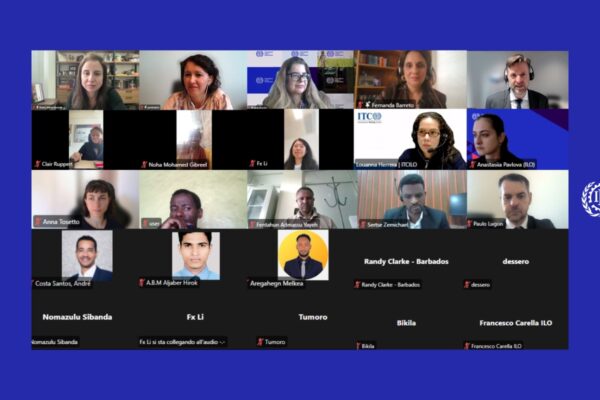
6 October 2026 | Geneva — The International Labour Organization (ILO), together with the International Training Centre of the ILO (ITCILO), convened the second session of the BRICS South-South and Triangular Cooperation Knowledge Series 2026, bringing together technical perspectives, country experiences and practical approaches to advancing women’s empowerment, formalisation, digitalisation and social protection across BRICS countries.
Held online on 6 October, the session built on the inaugural Knowledge Series exchange and focused on how countries can learn from one another in addressing interconnected challenges in labour markets and social protection. The discussion examined social security and formalisation, women’s participation and inclusion in the workforce, the use of digital technologies to extend protection to workers in informal, gig and platform employment, and opportunities for continued South-South peer learning.
Opening and co-moderating the session, Anita Amorim, Head of the Emerging and Special Partnerships Unit (ESPU) and Coordinator of South-South and Triangular Cooperation in the ILO’s PARTNERSHIPS Department, and Guillaume Mercier of the ITCILO, framed the exchange around the practical value of comparing national experiences and identifying approaches that can be adapted to different contexts. They emphasized the importance of moving from dialogue towards sustained peer learning and practical cooperation among BRICS countries.
The Brazilian perspective was presented by Maira Lacerda, Chief of the External Relations Office at Brazil’s Ministry of Labour, who was the Sherpa of the BRICS LEMM in 2025 and presided the Employment Working Group during the Brazilian presidency in BRICS. Her contribution examined formalisation, gender equality, digitalisation and social protection, drawing on Brazil’s experience of the BRICS Presidency and its approach to South-South and Triangular Cooperation. The discussion also explored opportunities for practical peer learning among BRICS countries.
Ira Postolachi, Project Technical Officer on Gender Equality and Non-Discrimination in the ILO’s Gender Equality, Diversity and Inclusion (GEDI) team, addressed women’s empowerment in the workforce, with particular attention to the gender equality and inclusion dimensions of formalisation, digitalisation and social protection in the context of the Indian BRICS Presidency. The discussion highlighted the importance of ensuring that policy and digital systems take account of different barriers and outcomes experienced by women.
The session also featured Fernanda Barreto from the ILO Brasilia Office and the Social Justice for the Global South Programme, who provided discussant reflections on the links between the programme, BRICS perspectives, gender equality, inclusion, formalisation, digitalisation and social protection. Her contribution helped place the technical discussion within the broader context of social justice and shared challenges across the Global South.
The digitalisation dimension was explored by Feixia Li, who presented experiences from selected BRICS countries on the use of digital technologies in social protection. Her contribution considered how digital tools can support registration, identification, access, delivery and coverage for workers in diverse and informal forms of employment, while also drawing attention to implementation lessons, enabling conditions and challenges.
A distinctive feature of the session was the BRICS Avatar, facilitated by partners together with Anita Amorim and Guillaume Mercier. Designed as a discussion tool rather than a representation of any single worker or country, the Avatar enabled participants to test the issues raised during the technical presentations against different national realities. Participants were invited to identify points of exclusion, consider existing measures that could improve a worker’s pathway towards formalisation and effective social protection, and reflect on which practices could be adapted across BRICS contexts.
The interactive exercise was followed by a moderated BRICS dialogue and participant exchange, focusing on how formalisation can lead to effective access to rights and social protection rather than registration alone; how gender considerations can be integrated into formalisation and digitalisation strategies; and where digitalisation has expanded access—or created new forms of exclusion—for informal and non-standard workers. Participants also considered the institutional conditions needed to make these approaches work and identified potential priorities for future BRICS peer-learning activities.
The session underscored several common lessons. Formalisation is most meaningful when it connects workers to effective rights, services and social protection. Gender considerations need to be incorporated into the design of formalisation and digital systems from the outset, while digitalisation can expand access only when challenges relating to connectivity, documentation, digital literacy, data governance and accessible non-digital channels are addressed.
The exchange also reinforced the role of South-South and Triangular Cooperation as a mechanism for mutual learning and adaptation. Rather than simply transferring a model from one context to another, effective cooperation requires understanding why an approach worked, which conditions supported it and how it may need to be adapted in a different national setting.
The second session forms part of the BRICS South-South and Triangular Cooperation Knowledge Series 2026, which aims to connect technical expertise and country experience with practical opportunities for peer learning and continued cooperation. The session also identified areas for follow-up through the South-South Meeting Point, including further comparative learning and exchange on formalisation, gender equality, digitalisation and social protection.
The ILO and ITCILO thanked Maira Lacerda, Ira Postolachi, Fernanda Barreto, Feixia Li for their contributions, as well as co-moderators Anita Amorim and Guillaume Mercier and all participants who contributed country experiences, questions and perspectives to the discussion.