
GENEVA – Several weeks after the launch of its new portfolio of South-South and Triangular Cooperation (SSTC) initiatives, the International Labour Organization (ILO) is already seeing strong momentum across regions as projects move from design to implementation.
The new generation of SSTC initiatives, covering Africa, Asia and the Pacific, Europe and Central Asia, the Arab States, Latin America and the Caribbean, and the BRICS framework, continues to strengthen regional and inter-regional cooperation on digitalization, formalization, care policies, labour market recovery and social protection. As implementation kicks off, these projects will begin consolidating platforms for peer learning, institutional exchange and evidence-based policymaking.
BRICS cooperation gains momentum under India’s Presidency
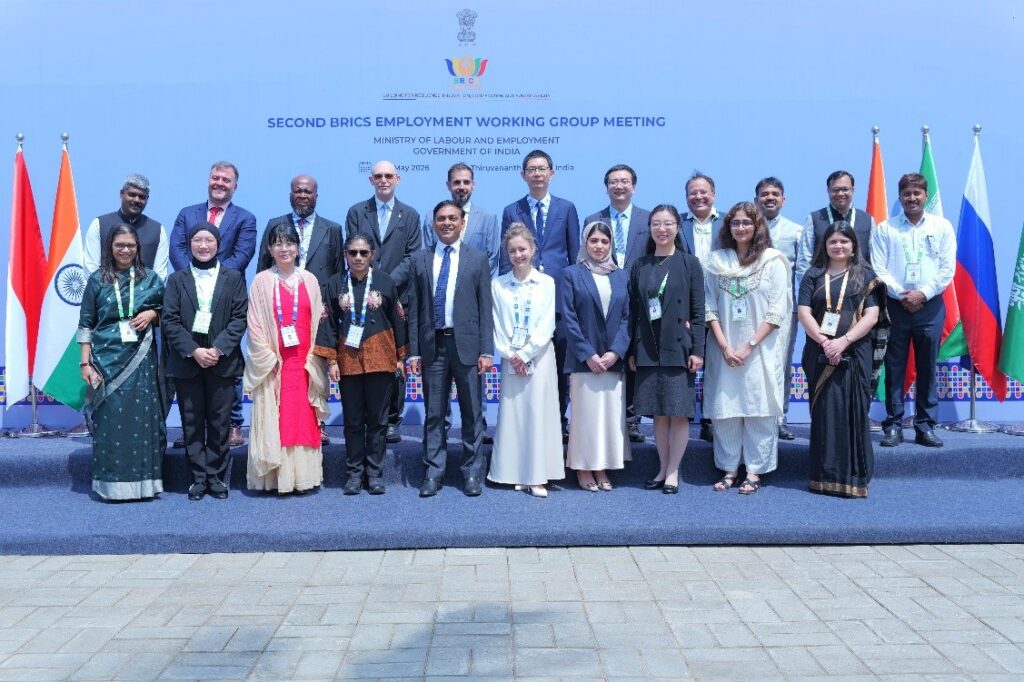
At the inter-regional level, cooperation within the BRICS framework is progressing rapidly in parallel with discussions led by India’s Presidency under the Employment Working Group (EWG) meetings and the Labour and Employment Ministers’ Meeting (LEMM), scheduled for mid-July.
A key innovation under this project is the revitalization of the BRICS Virtual Liaison Office (VLO), which will serve as a unique platform for exchanging experiences, sharing innovations, strengthening institutional capacities and promoting evidence-based policymaking on social protection and digital transformation. Through this mechanism, the ILO continues to support the institutionalization of knowledge-sharing processes among BRICS countries.
Arab States preparing regional forum on return and reintegration
In the Arab States, preparations are underway for a regional forum focused on labour market recovery, return and reintegration. The thematic priorities of the forum are being defined by tripartite constituents to ensure relevance and ownership.
The forum will provide a structured space for dialogue on labour inclusion, economic recovery and coordinated policy responses, contributing to a regional framework aligned with the Humanitarian–Development–Peace Nexus.
South4Care platform takes shape in Asia and the Pacific
In Asia and the Pacific, the SSTC initiative is entering an operational phase with renewed efforts to revamp thematic spaces on care policies across different subregions, via the South4Care platform. This latter is expected to play an instrumental role in facilitating exchanges on care systems, decent work, and social protection, while supporting countries in adapting innovative policy approaches to their national contexts.
By strengthening inter-regional cooperation, South4Care is positioning itself as a practical mechanism for knowledge exchange and policy innovation in the care economy.
Comparative study launched in Eastern Europe and Central Asia
In Eastern Europe and Central Asia, implementation has begun with the focus on a comparative study examining care economy policies across selected countries. The study aims to identify common trends, policy gaps and innovative practices that support women’s participation in labour markets and strengthen care systems.
Its findings will inform future technical exchanges and support the creation of a roadmap and reports.
Latin America and the Caribbean expand digital exchange on employment services
In Latin America and the Caribbean, the project is leveraging the existing South-South Meeting Point platform to have a dedicated virtual space for countries to exchange knowledge, upload resources and practical manuals, and store webinars.
This digital environment will support the strengthening and modernization of Public Employment Services (PES), enhancing capacities for job intermediation, career guidance and labour market inclusion throughout the region.
PALOP countries in Africa map formalization good practices
In PALOP countries, the project is currently in its mapping phase, identifying good practices and innovative digital solutions that support the transition from informal to formal economies.
The next step will involve the development of Portuguese-language technical policy briefs to facilitate knowledge-sharing and support evidence-based adaptation among participating countries.
As these initiatives continue to evolve, the ILO’s SSTC framework reinforces its role as a catalyst for peer-driven development cooperation, enabling countries of the Global South to jointly shape solutions, strengthen institutions and accelerate progress toward inclusive and resilient labour markets.