
GENEVA/BANGKOK, 14 October 2026 – Strengthening cooperation among countries of the Global South can help transform the care economy into a driver of decent work, gender equality and inclusive development, participants emphasized during an International Labour Organization (ILO) dialogue on “South-South and BRICS Perspectives on Decent Work, Care and the Care Economy”.
Organized as part of the South-4-Care Learning Hub, the dialogue brought together expertise from the ILO, India’s V.V. Giri National Labour Institute, the International Domestic Workers Federation (IDWF) and the Indonesian Employers’ Association (APINDO). Participants explored how experiences from India, Indonesia and other Global South contexts can inform policies for decent work and gender equality, while identifying practical opportunities for South-South and BRICS cooperation.
The discussion highlighted the importance of bringing together governments, workers, employers, researchers and international organizations to address the care economy from complementary perspectives. Participants considered policy and institutional approaches, decent-work deficits affecting domestic and other care workers, employers’ priorities, and opportunities to exchange knowledge and practices across countries.
Turning Global South experience into shared solutions
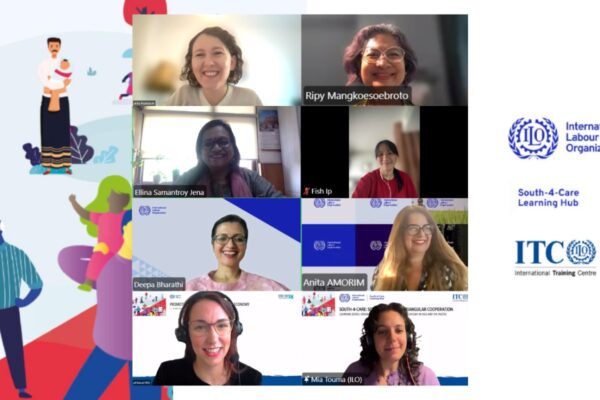
Dr Ellina Samantroy, Sociologist and Fellow at the V.V. Giri National Labour Institute in India, brought more than two decades of experience in research, teaching, training and policy development on gender and labour, unpaid work, time use, women in the informal economy, social protection and labour laws. Her work, including her coordination of the Institute’s Research Centre for Gender and Labour, highlights the importance of connecting research and institutional capacity with practical policy action. She also contributes to international collaboration, including through BRICS and ILO partnerships.
From the workers’ perspective, Fish Ip (Ip Pui Yu), Asia-Pacific Regional Coordinator of the International Domestic Workers Federation, brought more than two decades of experience in labour organizing, particularly in support of informal-sector and migrant domestic workers. Her expertise in grassroots leadership, legal protections and labour standards underscored the importance of workers’ rights, representation and social protection in building a care economy that delivers decent work. South-South cooperation can help strengthen these efforts by enabling workers’ organizations to exchange experiences and approaches across countries.
Representing the employers’ perspective, Ripy Retno Hermijanti, Committee Member of the Indonesian Employers’ Association (APINDO), drew on more than 30 years of human resources leadership and experience in labour legislation, worker protection and organizational transformation across several sectors. Her experience highlighted the role employers can play in advancing decent work, women’s empowerment and the inclusion of vulnerable groups in both the formal and informal economy. The discussion also explored how employer-led practices and institutional partnerships could inform cooperation among countries in ASEAN, BRICS and the wider Global South.
Connecting gender equality, care policy and decent work
Ira Postolachi, Project Technical Officer on Gender Equality and Non-Discrimination in the ILO’s Gender Equality and Non-Discrimination (GEDI) Branch, within the PROTECTION Department, brings expertise in research, policy analysis and technical cooperation to advance transformative gender equality policies. Her work focuses particularly on care, equal pay, and violence and harassment in the world of work. These areas are closely connected to the challenge of ensuring that care systems support gender equality while protecting the rights of care workers.
Mia Touma, Technical Officer in Care Policies at the ILO, presented resources available through the South-4-Care platform and highlighted how knowledge tools can support policy development and learning across countries. Since joining the ILO in 2022, her work has contributed to the development and launch of the ILO Global Care Policy Portal, the Care Policy Investment Simulator and the South-4-Care Platform, as well as research on decent work and the care economy. This includes the ILO’s 2024 International Labour Conference report on Decent Work and the Care Economy and the publication Care at Work in the Middle East and North Africa.
The session was moderated by Deepa Bharathi, ILO Senior Specialist on Gender Equality, Non-Discrimination and Inclusion for Asia and the Pacific. Her work at the ILO has focused on equality and non-discrimination, decent work for women migrant workers, and efforts to end gender-based violence and harassment. Previously, she worked at the UN Women Regional Office for Asia and the Pacific, focusing on gender equality, gender-responsive labour migration and access to justice, and collaborated with research institutions, non-governmental organizations and women workers’ organizations.
From exchange to practical South-South cooperation
In closing, Anita Amorim, Head of the ILO’s Emerging, South-South & Special Partnerships Unit, connected the discussion to the wider South-South and BRICS cooperation agenda. Her work at the ILO focuses on strengthening collaboration with international and regional alliances, including BRICS, IBSA, the Gulf Cooperation Council (GCC), the Group of 77 and China, and the Organisation for Economic Co-operation and Development (OECD), to advance decent work through South-South and triangular cooperation.
The dialogue highlighted the importance of moving beyond the exchange of experiences towards concrete cooperation offers, requests and follow-up actions. Potential areas include peer learning among institutions, research and training partnerships, exchanges among workers’ and employers’ organizations, dissemination and adaptation of effective practices, and the use of South-South and triangular cooperation to connect expertise and solutions across countries.
South-South and triangular cooperation offers a practical framework for advancing the care agenda. Countries of the Global South face many common challenges while developing diverse policy responses, institutional approaches and forms of worker organization. Structured opportunities for countries and social partners to learn from one another can help adapt relevant experiences to different national circumstances.
BRICS and other Global South platforms can also provide spaces for cooperation on the care economy, linking decent work with gender equality and women’s economic empowerment. By connecting governments, social partners, research institutions and international organizations, these platforms can help translate shared priorities into practical collaboration.
The dialogue forms part of a broader effort to strengthen South-4-Care as a platform not only for sharing knowledge, but also for building partnerships. By connecting policy evidence, workers’ experiences, employers’ engagement and international cooperation, the initiative seeks to support practical solutions that advance decent work and gender equality throughout the care economy.