
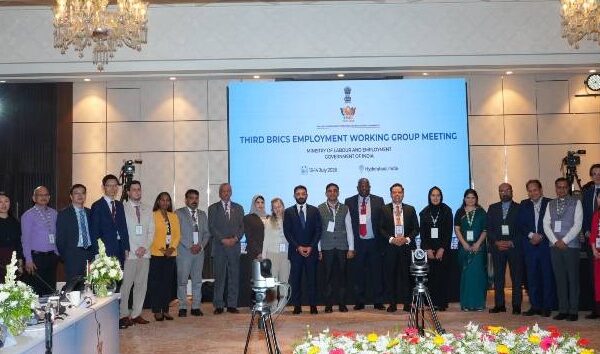
Hyderabad, Telangana, 14 July 2026 – The International Labour Organization (ILO) welcomed the constructive discussions held during the third BRICS Employment Working Group (EWG) meeting on 13–14 July under India’s Presidency, held under the theme “Building for Resilience, Innovation, Cooperation and Sustainability.” Representatives of BRICS member countries advanced dialogue on four priorities to promote inclusive labour markets, decent work and sustainable economic development.
Priority I: Advancing social security and formalization of labour markets
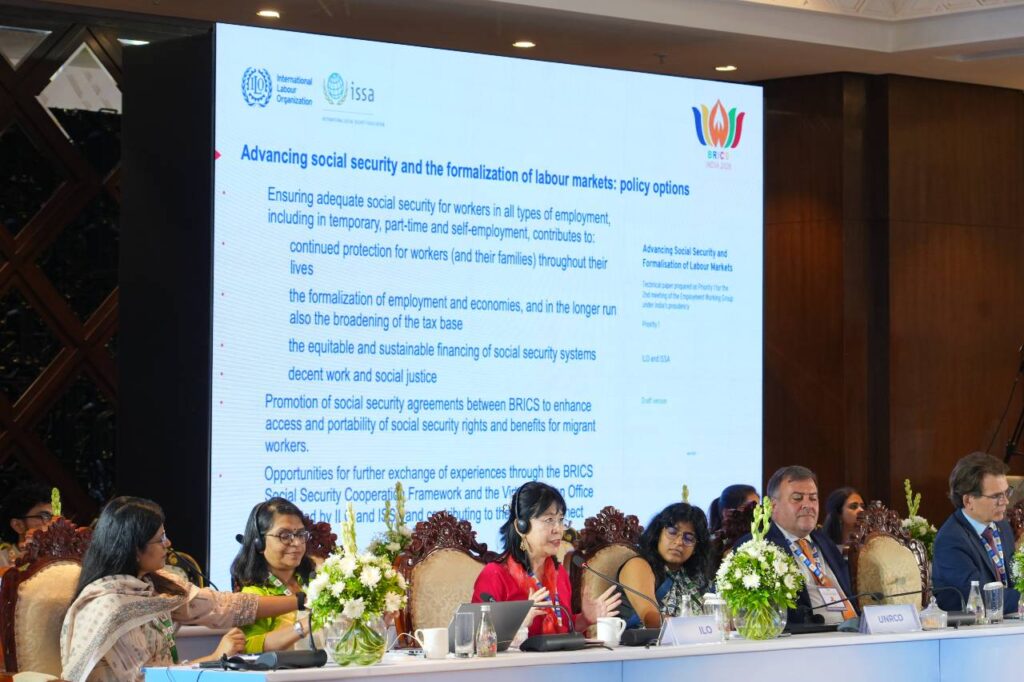
Building on the deliberations of the previous EWG sessions by the India’s Presidency on the first priority, delegates reaffirmed the importance of strengthening social protection systems and supporting the transition to formal employment. Discussions highlighted policy options to extend adequate social security coverage to workers in all forms of employment, including those in temporary, part-time and self-employment and in the informal sector, recognizing that comprehensive social protection contributes to greater labour market formalization, improved resilience, equitable and sustainable financing of social protection systems and social justice. Participants also underlined the importance of international cooperation, including through social security agreements and strengthened knowledge exchange within the BRICS Social Security Cooperation Framework and the BRICS Social Security Virtual Liaison Office (VLO) supported by the ILO and the International Social Security Association (ISSA).
Priority II: Enhancing women’s participation and inclusion in the workforce
The Working Group also reviewed progress on advancing the care economy as a driver of inclusive growth, gender equality and increased women’s labour market participation. Discussions emphasized integrated care policies and services that recognize, reduce and redistribute unpaid care work while rewarding and representing paid care workers. Delegates shared national experiences on promoting equal opportunities through measures such as pay equity and transparency, expanded childcare and long-term care services, work-life balance policies and paid parental leaves, support for women’s entrepreneurship and return to work, and stronger legal protections against discrimination and violence in the workplace. Participants also stressed that improving women’s labour market outcomes requires coordinated, integrated and comprehensive action across labour, education, social protection, safety and health and family policies, supported by social dialogue, investments in care economy and continued international cooperation.
Priority III: Cooperation on employability, skills mapping and development
On the third priority, delegates explored opportunities to strengthen cooperation on skills mapping, skills recognition and workforce development to respond to rapidly evolving labour market needs. National experiences highlighted integrated skills ecosystems linking education and training institutions, employers, public employment services and digital platforms, together with apprenticeships, work-based learning and competency-based training to facilitate school-to-work transitions. Participants also emphasized the growing use of labour market intelligence, digital employment services and skills forecasting to guide workforce planning, alongside lifelong learning, recognition of prior learning and the development of digital, green and other future-oriented skills. The discussions underscored the potential for enhanced BRICS cooperation on skills recognition, labour mobility and the exchange of knowledge and good practices.
Priority IV: Leveraging digital technologies for unorganized workers, including gig and platform workers
The fourth priority area focused on leveraging digital technologies to better protect all workers, including those engaged in the platform economy. Participants discussed policy approaches to ensure that digital transformation supports inclusive social protection systems, enhances access to benefits and services, strengthens governance and interoperability of digital systems, and promotes decent work in line with international labour standards. The discussions also highlighted the value of continued cooperation on digital innovation, capacity building and knowledge exchange through existing BRICS collaborative mechanisms.
ILO support to BRICS
Throughout the meeting, the ILO delegation presented examples of its technical support to member States across the four priority areas, including policy advice, capacity building, statistical development, legal and institutional strengthening, digital innovation, and practical knowledge products. The ILO reaffirmed its commitment to supporting BRICS countries in advancing social protection, labour market formalization, skills development, inclusive care policies and digital transformation to promote decent work for all.
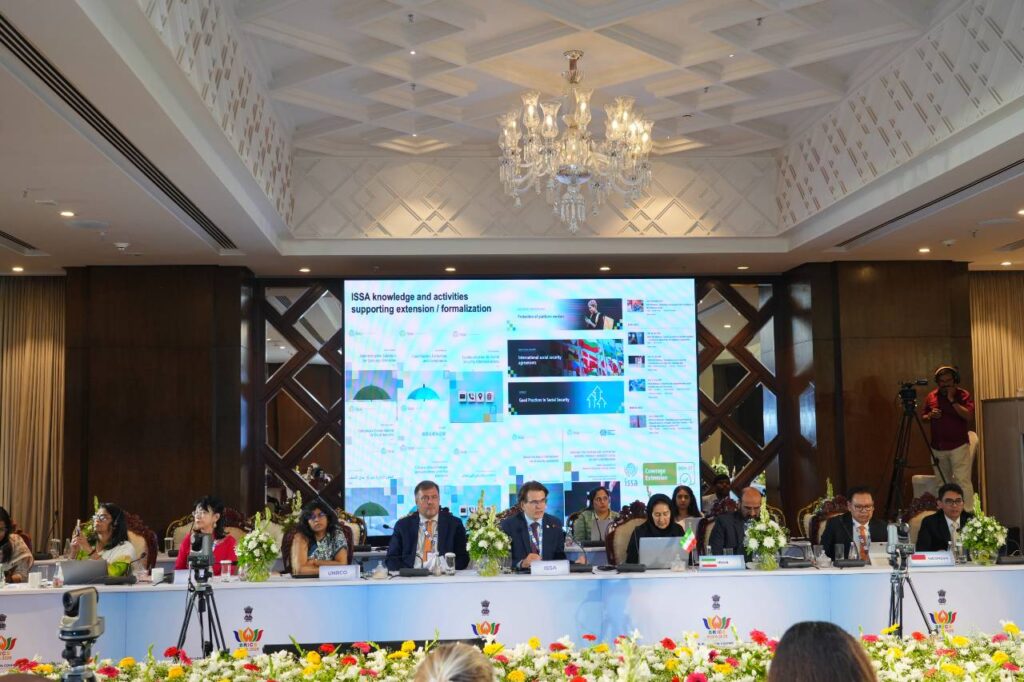
The meeting reaffirmed the shared commitment of BRICS members to strengthen cooperation and exchange practical experiences in addressing common labour market challenges. Its outcomes will contribute to advancing the BRICS employment agenda and the upcoming Labour and Employment Ministers Meeting (LEMM) under India’s Presidency, and promoting more inclusive, resilient and sustainable labour markets.