
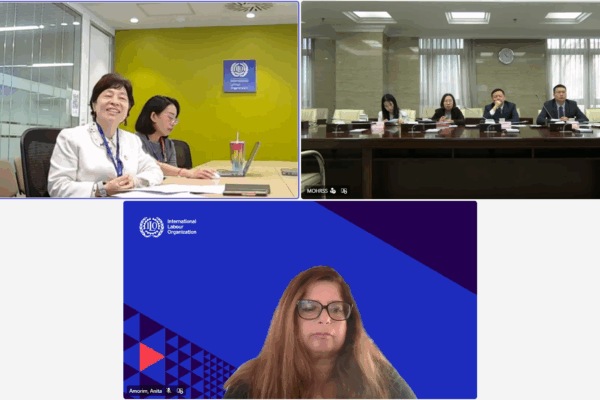
The third Project Steering Committee Meeting of the ProSSCE-ASEAN project convened partners from the Ministry of Human Resources and Social Security of China and the International Labour Organization to review progress, assess impact and shape the strategic direction for the coming year.
In 2025, the ProSSCE-ASEAN project consolidated its third year of implementation by deepening its impact on inclusive employment and labour market resilience across ASEAN. The project strengthened regional policy dialogue, institutional capacity and knowledge exchange under three operative pillars: policy development, capacity-building for public employment services (PES) and entrepreneurship, and research and South-South and Triangular Cooperation (SSTC). Key achievements included a high-level Regional Policy Dialogue on high-quality and full employment, the launch of a comparative study on green entrepreneurship policies, and capacity-building initiatives such as the ITCILO youth employment programme and four-tiered PES training in Cambodia and Indonesia. Since inception, the project has reached more than 186,000 beneficiaries, including significant numbers of women, youth and persons with disabilities, while connecting nearly 150,000 jobseekers in Cambodia to employment opportunities through career fairs.
The project also reinforced strategic alignment with ASEAN priorities, the Sustainable Development Goals (notably SDG 8), and China’s Global Development Initiative, positioning South-South cooperation as a central driver of innovation and shared learning. Strong collaboration with the ASEAN Secretariat and the Ministry of Human Resources and Social Security of China supported policy integration, knowledge exchange and scalable employment service models. Despite challenges such as diverse national priorities, political transitions and limited in-country presence, the project strengthened tripartite engagement, mainstreamed gender, youth and disability inclusion, and advanced sustainability by embedding practices into national systems. Looking ahead, it aims to scale up successful pilots, deepen regional cooperation and reinforce institutional ownership to ensure lasting impact across ASEAN.
The meeting opened with remarks from Mr. Jiang Wei on behalf of the Department of International Cooperation of the Ministry of Human Resources and Social Security of China, Ms. Anita Amorim from the ILO Partnerships Department, and a Xiaoyan Qian DWT/CO Director, DWT-Bangkok and Sheng Ling, Project Manager of ProSSCE ASEAN. Their interventions reaffirmed the shared commitment to advancing South-South and Triangular Cooperation and strengthening employment systems across ASEAN.
At the core of the discussion was the presentation of the 2025 Annual Progress Report by the Project Team. The review demonstrated how the project has continued to expand its regional footprint while deepening country-level impact. Across ASEAN Member States, employment services were strengthened, career guidance systems improved, and institutional capacities enhanced. Particular emphasis was placed on large-scale outreach to jobseekers, including women, youth and persons with disabilities, as well as the reinforcement of public employment service systems through structured training and South-South replication models.
The Committee also examined how the project has reinforced ASEAN’s policy dialogue architecture. Regional exchanges and technical discussions have supported collective responses to digital transformation, platform work, green transition and broader labour market shifts. National-level engagement has contributed to employment policy development and review processes, embedding tripartite perspectives and long-term sustainability considerations.
A dedicated segment focused on project visibility and knowledge dissemination. The Project Team outlined how research outputs, regional dialogues and peer learning initiatives have strengthened the project’s profile as a practical platform for cooperation between China and ASEAN, while contributing to evidence-based policymaking and shared regional public goods.
Looking ahead, the proposed 2026 annual workplan and budget were presented for consideration. Discussions centered on consolidating successful interventions, scaling up proven training and service delivery models, and aligning future activities with evolving regional priorities. Steering Committee members also reflected on the project’s operational timeline and strategic orientation beyond 2026, taking into account the changing development landscape and institutional review processes.
The meeting concluded with a clear sense of continuity and ambition: to further institutionalize results within national systems, enhance regional integration through practical cooperation, and sustain the momentum of South-South and triangular partnerships in support of decent work and inclusive growth across ASEAN.
The meeting reviewed progress and validated results of the China–ILO South-South and Triangular Cooperation project, discussed priorities for implementation in 2026, and explored options to sustain and potentially extend the initiative beyond 2026. Participants commended the strong momentum, high demand from partner countries, and the project’s value as a flagship SSTC model based on partnership and mutual learning, emphasizing the need to consolidate achievements, ensure continuity of successful interventions, and align future activities with ILO and national priorities, including digitalization, localization of employment policies, informality, just transition, and crisis response. The discussion stressed strengthening regional policy dialogues, the expert network, and other knowledge-sharing platforms, while increasing visibility through robust impact stories and communications to broaden outreach (including to BRICS and other partners) and mobilize additional resources. Several continuation modalities were noted—an amendment/extension, a second phase, or a new project agreement—and it was agreed that a comprehensive end-of-phase assessment and further consultations with the Government of China and ILO technical colleagues would be essential to determine the most appropriate approach.
Mr. Sheng Ling, ProSSCE ASEAN project manager reaffirmed that a project extension would be very welcome and stressed the importance of having a first South-South initiative under China’s Global Development Initiative. MOHRSS representatives mentioned that this linkage is important and that the project came under the auspices of the Year of the Horse.