
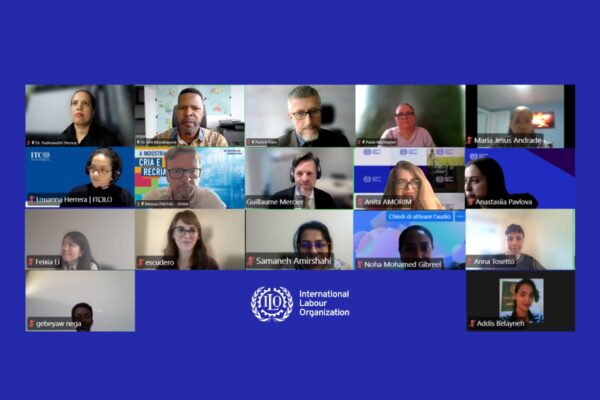
20 November 2026, Geneva – The International Labour Organization (ILO), through its PARTNERSHIPS Department, Emerging, Special and South-South Partnerships Unit (ESPU), in collaboration with the ILO Skills Branch and the International Training Centre of the ILO (ITCILO), convened the second session of the BRICS & Skills Knowledge Series, focusing on strengthening skills systems for employability and the world of work through South-South and triangular cooperation.
Held online under the theme “From skills intelligence to action: demand-responsive training, apprenticeships and social dialogue in BRICS economies”, the dialogue brought together ILO experts and representatives from BRICS countries to exchange experiences on translating skills intelligence into relevant training programmes, updated occupational standards and effective pathways into employment.
Discussions explored how employers’ and workers’ organizations, sector skills councils and training institutions can work together to ensure that skills development responds to the evolving needs of enterprises and workers. Particular attention was given to apprenticeships, work-based learning and training opportunities in the green, digital and care economies, including for young people, women and groups facing barriers to labour market entry.
Ms. Paula Montagner, Ministry of Labour Brazil-Sub Secretary for Statistics and Labour Studies, Dr. Padmavathi Shenoy Institutional Affiliation: Senior Academic & Social Impact Consultant, SELCO Solar Light Pvt Ltd (India), Patrick Daru, Head of Unit, SKILLS, ILO and Mateus Freitas, Business Educational Manager, Senai – National Department, discussed how can BRICS countries make skills systems more demand-responsive and strengthen the school-to-work and work-to-work transitions.
Drawing on experiences from countries including Brazil, India and South Africa, participants highlighted the value of sharing practical approaches and strengthening institutional partnerships. Examples included Brazil’s SENAI model of public-private training delivery, approaches to occupational standards and competency development, and South Africa’s experience with apprenticeships and centres of specialisation.
The session underscored the potential of South-South and triangular cooperation to move beyond the exchange of knowledge towards practical collaboration between institutions, training providers and social partners. Peer learning, adaptation of proven practices and institution-to-institution exchanges can help BRICS countries develop more inclusive, responsive and effective skills systems.
The dialogue also contributes to Priority 3 of India’s 2026 BRICS Presidency, on Cooperation on Employability, Skills Mapping and Skills Development, while reinforcing the ILO’s commitment to promoting decent work through international cooperation and tripartite engagement.
The BRICS & Skills Knowledge Series is designed to advance South-South and triangular cooperation on skills, productivity and the future of work, providing a platform for policy dialogue, knowledge exchange and practical partnerships among BRICS countries and other interested partners.