
ILO policy dialogue brings together BRICS perspectives and international expertise to advance cooperation on skills anticipation, labour market intelligence and skills recognition.
13 November 2026 | Geneva – The International Labour Organization (ILO) convened the first session of the BRICS Skills Development Policy Dialogue Series: Advancing South-South Cooperation on Skills, Productivity and the Future of Work, focusing on opportunities to strengthen collaboration among BRICS countries in anticipating future skills needs and responding to rapidly changing labour markets.
Entitled “Anticipating Skills Needs in BRICS Economies: From National Skills Forecasting to a BRICS Community of Practice on Skills Intelligence,” the online dialogue provided a platform for exchanging policy experiences and exploring practical opportunities for South-South and Triangular Cooperation (SSTC).
The initiative comes at a critical moment as artificial intelligence, digitalization, the green transition and demographic changes reshape occupations, production systems and the skills required by workers and enterprises. While BRICS countries face different national circumstances, they share important challenges in addressing skills mismatches, strengthening technical and vocational education and training (TVET), and ensuring that technological transformation contributes to productive employment and decent work.
Building on India’s BRICS Presidency and G20 commitments
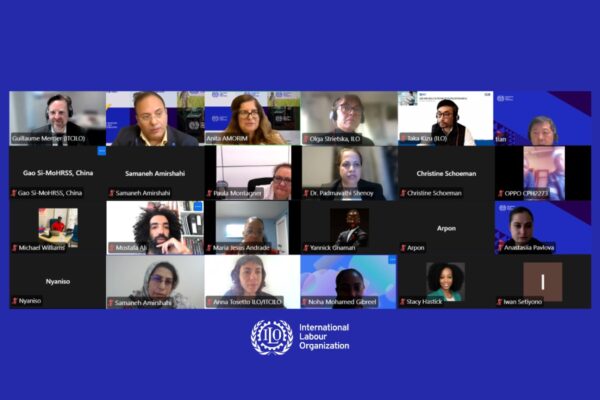
Opening the session, Anita Amorim, Head of the Emerging, Special and South-South Partnerships Unit at the ILO, introduced the strategic importance of South-South and Triangular Cooperation in advancing skills development across BRICS economies.
The dialogue forms part of broader efforts to connect the policy experiences, technical capacities and institutional networks of emerging and developing economies, encouraging mutual learning and practical cooperation rather than one-way transfers of knowledge.
Guillaume Mercier, ILO moderator, introduced the objectives of the Policy Dialogue Series and facilitated discussions on opportunities for stronger institutional collaboration among BRICS countries.
A central contribution was provided by Chaman Guleria, Director at the Ministry of Labour and Employment of the Government of India, who was invited to address India’s leadership in international skills cooperation, including the continuity between commitments under India’s 2023 G20 Presidency and the priorities of its 2026 BRICS Presidency.
A key area of attention was the India-funded ILO initiative examining the feasibility of developing an international reference classification of occupations based on skills and qualification requirements.
This initiative offers opportunities to strengthen transparency, comparability and recognition of skills across countries, while ensuring that international approaches adequately reflect the diverse labour market realities and development priorities of emerging and developing economies.
The discussion also provided an opportunity to consider how the BRICS Cooperation Network for Capacity Building, Employability, and New Skills and Technologies (BRICS CONNECT) could contribute to sustained collaboration on skills development.
Strengthening skills intelligence through international cooperation
The technical dimension of the dialogue featured Olga Strietska-Ilina, Head of the Future Skills Unit at the ILO, and Takaaki Kizu, ILO Future Skills Unit.
Their contributions focused on skills anticipation, labour market intelligence and the international skills taxonomy initiative, highlighting areas where ILO methodologies and technical expertise can support cooperation among BRICS institutions.
Strengthening skills intelligence is particularly important for helping governments, employers’ and workers’ organizations, and training institutions anticipate changing occupational requirements and align education and training systems with emerging economic opportunities.
The session explored the potential for greater cooperation in skills forecasting, occupational classifications, joint research and the exchange of methodologies and institutional experiences.
A proposed BRICS Community of Practice on Skills Intelligence emerged as a central area for further exploration, offering a possible mechanism for connecting technical institutions, sharing knowledge and supporting cooperation on digital, green and future-oriented skills.
Learning from South-South cooperation between China and ASEAN countries
The dialogue also drew on practical experiences of South-South and Triangular Cooperation, including the ILO/China Partnership Programme on Strengthening Skills Development in ASEAN.
Tian Feng, Project Manager at the ILO Regional Office for Asia and the Pacific, contributed perspectives from this programme, illustrating how cooperation between China, the ILO and ASEAN partner countries can help translate shared development priorities into practical institutional partnerships and skills development initiatives.
Launched in 2020 with a contribution of USD 5 million from China, the programme has implemented approximately 195 activities, reaching more than 789,000 direct and indirect beneficiaries, according to programme figures presented for the session.
Its activities have supported policy development, skills research, capacity-building, inclusive employment and institutional partnerships, including a South-South Cooperation Skills Development Network connecting 40 TVET institutions in China and ASEAN.
These experiences demonstrate the potential of South-South cooperation to strengthen institutional capacities, promote mutual learning and connect skills development with employment opportunities for young people, women, persons with disabilities and migrants.
Building on these lessons, the presentation identified three possible directions for broader BRICS cooperation: establishing a community of practice on skills intelligence; developing joint pilot initiatives on digital, artificial intelligence and green skills; and strengthening institutional partnerships through technical exchanges and cooperation among vocational training institutions.
The experience also points to opportunities for stronger cooperation between BRICS and ASEAN countries, linking existing networks and technical capabilities with emerging priorities in skills development.
From policy dialogue to practical partnerships
The interactive policy dialogue, moderated by Guillaume Mercier, provided space to explore opportunities for cooperation on skills anticipation, occupational classifications and skills recognition from a South-South perspective.
The discussion agenda placed particular emphasis on the role of national institutions, research organizations, vocational training providers and social partners in translating policy dialogue into practical collaboration.
Potential areas for follow-up include institutional exchanges, joint research, technical cooperation, the adaptation of successful approaches to different national contexts and the development of a BRICS Community of Practice on Skills Intelligence.
These opportunities reflect the broader objective of promoting cooperation based on national ownership, reciprocity, mutual benefit and the complementary strengths of participating countries.
Towards a BRICS skills cooperation agenda
Anastasiia Pavlova, ILO, was responsible for the session’s closing remarks and the introduction of next steps for the BRICS Skills Development Policy Dialogue Series.
The first dialogue forms part of a series of three online sessions scheduled for 13, 18 and 25 November 2026, covering complementary dimensions of skills development.
The subsequent sessions will address demand-responsive training, apprenticeships and social dialogue, followed by flexible learning pathways, recognition of prior learning, micro-credentials and career guidance.
Together, the dialogues aim to identify practical opportunities for cooperation among BRICS institutions and contribute to the progressive development of a longer-term BRICS skills cooperation agenda.
As BRICS countries seek to respond to technological change, economic transformation and evolving labour market demands, South-South and Triangular Cooperation offers an important pathway for transforming shared knowledge into concrete partnerships, stronger institutions and more inclusive opportunities for decent work.
Through its convening role, technical expertise and commitment to international labour standards, the ILO can help facilitate this cooperation, supporting countries in developing skills systems that are responsive, inclusive and equipped for the future of work.
About the initiative
The BRICS Skills Development Policy Dialogue Series is organized by the ILO Emerging, Special and South-South Partnerships Unit in collaboration with ILO skills specialists and BRICS partners. The series promotes knowledge exchange, institutional cooperation and practical South-South and Triangular Cooperation on skills development, productivity and decent work.