
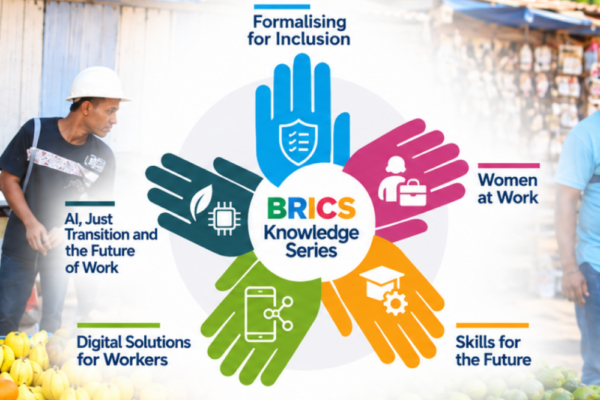
BRICS Knowledge Series 1 — Formalizing for Inclusion: Pathways to Decent Work
Across BRICS countries and the wider Global South, governments and social partners are exploring new ways to extend social protection, promote the transition to formality and ensure that no worker is left behind. South-South cooperation provides a practical framework for countries to learn from solutions developed in comparable contexts and to adapt them to national realities.
Effective solutions cannot simply be transferred from one context to another. They need to be shared, discussed and adapted through peer exchange – with participating countries and institutions recognised as both providers and beneficiaries of knowledge.
Formalizing for Inclusion is the first series of the BRICS South-South Knowledge Series: three interactive webinars bringing together policymakers, practitioners, ILO specialists and experts from BRICS countries and the wider Global South to exchange experiences and explore practical approaches to advancing formalisation and social protection.
The series supports the continuity of BRICS cooperation across the Troika of Brazil, India and China, connecting successive BRICS priorities through practical South-South exchange. It responds to the priorities endorsed by BRICS Labour and Employment Ministers in 2026, including advancing social protection and the formalisation of labour markets through stronger cooperation and exchange of experience, while creating a platform to carry forward areas of particular relevance to India, including AI, the BRICS Virtual Liaison Office (VLO), social protection, women empowerment and digitalization.
What will you gain?
Through technical inputs, country experiences and facilitated South-South peer exchange, participants will:
- explore practical approaches to expanding social protection and promoting labour market formalisation;
- learn from policies, innovations and solutions developed across BRICS countries and the wider Global South, including experience relevant to AI, digitalization, women empowerment and the BRICS VLO;
- discuss common implementation challenges and opportunities with peers, strengthening continuity and cooperation across the Brazil-India-China Troika;
share and examine South-South cooperation good practices that can be adapted to different national contexts.
How does it work?
Three interactive online webinars taking place on 29 September, 6 October and 13 October. Every Tuesday at 13:00 CEST time (Geneva time).
Each webinar combines technical expertise and country experiences with facilitated peer learning, creating space for participants to share and discuss practical good practices from across the Global South.
The series will be delivered in English, with live captions provided in Portuguese and Mandarin Chinese.
Scholarships available
Participation is fully covered by a scholarship for applicants from the Global South for a maximum number of 50 selected participants.
The scholarship is linked to the submission of a good practice with a South-South and Triangular Cooperation (SSTC) dimension: not a generic case study, but a concrete experience of SSTC within your institution or country. The submission should describe the challenge it sought to address, the institutions and countries that cooperated in responding to it, its innovative elements and the results achieved, as well as its adaptability to other contexts.
It may be submitted as a short video of three to five minutes or using the written good practices form; the template and instructions are sent after the application is submitted. Submission does not, in itself, guarantee the award of a scholarship: submissions are reviewed and scholarships are awarded according to the number of places available.
How to participate
Places are limited. Applications must be submitted through the online form here.
- Application: Complete the online form by 23 September 2026.
- Good practice: Applicants who are eligible for a scholarship will receive, by email, instructions for submitting their good practice, including the template and upload link.
- Review and confirmation: Submissions are reviewed by the programme team. Selected applicants will then receive confirmation of their participation and access information.