
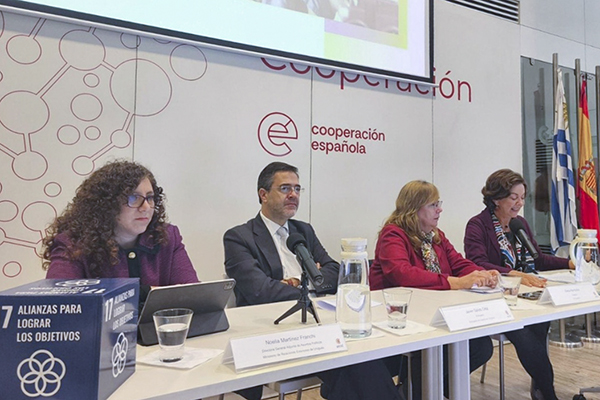
The Economic Commission for Latin America and the Caribbean (ECLAC), the International Labour Organization (ILO), and its Inter-American Center for Knowledge Development in Vocational Training (ILO/Cinterfor), together with the Spanish Agency for International Development Cooperation (AECID) and the Government of Uruguay, launched the project “Towards a Regional Qualifications Framework in the Care Sector” in Montevideo. This initiative aims to strengthen the professionalization, certification, and recognition of skills in the care sector in Latin America and the Caribbean.
At the opening of the event, Ana Güezmes, Director of ECLAC’s Gender Affairs Division, emphasized that the Commitment of Tlatelolco, adopted by the region’s governments at the XVI Regional Conference on Women in Latin America and the Caribbean, recognizes care as a human right, a necessity, a public good, and work. She also recalled that the countries agreed to launch a Decade of Action to accelerate progress toward substantive gender equality and advance toward a care society.
Ana Güezmes pointed out that the Tlatelolco Commitment mandates the promotion of public policies to formalize and professionalize paid care work. In this context, she indicated that the project constitutes a concrete response to the countries’ call to develop tools that contribute to the recognition and valuation of care work.
She also emphasized that advancing a regional qualifications framework will allow for the establishment of common benchmarks for skills recognition, facilitate labor mobility with protection of rights, and improve the quality of employment in a sector that is strategic for well-being and sustainable development. She added that these tools will contribute to skills recognition, the improvement of educational and career paths, and the strengthening of job quality in the care sector.
For her part, Elena Montobbio, Director of ILO/Cinterfor, stated that “professionalizing the care sector is a strategic step to improve the quality of employment, facilitate labor mobility, and promote sustainable career paths for those working in this sector, the majority of whom are women.”
The opening event included the participation of representatives from the Spanish Agency for International Development Cooperation (AECID), the Ministry of Foreign Affairs of Uruguay, ECLAC, and ILO/Cinterfor, who agreed on the importance of strengthening regional cooperation to promote the professionalization of care work and the recognition of skills in the sector.
The event included a regional panel on the challenges and opportunities for advancing the professionalization of care from a regional cooperation perspective. Authorities and representatives from training and certification institutions in various Latin American and Caribbean countries shared experiences and lessons learned regarding training, certification, and skills recognition in the care sector.
The project is supported by the regional network Saber Cuidar (Knowing How to Care), which brings together 24 vocational training and certification institutions from 14 countries in Latin America and the Caribbean. Through this platform, the initiative will promote the exchange of experiences, capacity building, and the development of common standards that contribute to improving the educational and employment pathways of care workers.
ECLAC reaffirmed its commitment to supporting this process, emphasizing that training, certification, and skills recognition systems are a fundamental component for advancing toward a care society, promoting decent work, and contributing to a development model with equality in Latin America and the Caribbean.
Source: https://www.cepal.org/en/node/86816