
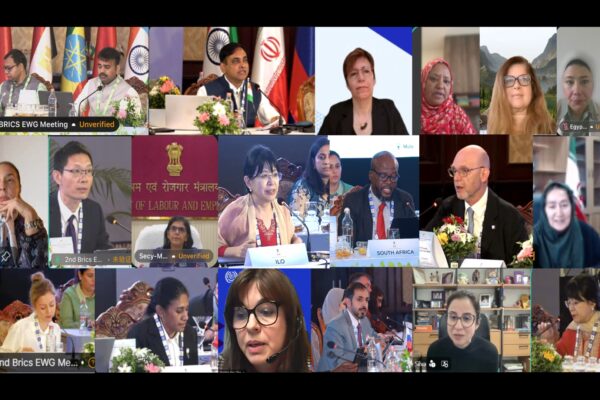
Kerala, India, 7 May 2026 — The 2nd BRICS Employment Working Group (EWG), held on 6–7 May 2026 in India, and online under India’s BRICS Presidency, brought together representatives of BRICS member countries, the International Labour Organization (ILO), the International Social Security Association (ISSA), the United Nations Resident Coordinator Office in India (UNRCO) to discuss cooperation on four priority areas: advancing social security and formalization of labour markets; enhancing women’s participation and inclusion in the workforce; cooperation on employability, skills mapping and skills development; and leveraging digital technologies for social protection. The importance of South-South cooperation and peer learning was highlighted by all knowledge partners.
Opening the meeting, India Secretary of Labour highlighted the importance of strengthening South-South and triangular cooperation to address shared labour market challenges, including informality, demographic change, digitalization, climate transition and skills mismatches. BRICS members broadly welcomed the priorities proposed under the Indian Presidency and reiterated that cooperation should remain voluntary, flexible and aligned with national priorities.
The ILO and ISSA highlighted progress made by BRICS countries in extending social protection coverage to more categories of workers, including digital platform workers and others in temporary, part-time and self-employment, while noting that important gaps remain, particularly among workers in the informal economy. Discussions emphasized the importance of ensuring adequate social protection for workers in all types of employment, and strengthening the links between social protection, formalization and decent work, as well as ensuring the sustainable and equitable financing and good governance of social protection systems in line with international social security standards.
Priority 1: Advancing social security and formalization of labour markets
Under Priority 1, India presented the proposed BRICS Capacity-Building Forum on Advancing Social Security 2026, aimed at supporting inclusive and sustainable social protection systems through technical exchanges, joint analytical work and strengthened data systems. Member States exchanged national experiences on extending social protection and formalizing labour markets, including measures to improve coverage and support workers in emerging forms of employment.
Priority 2: Enhancing women’s participation and inclusion in the workforce
On Priority 2, Member States reaffirmed their commitment to advancing women’s participation and inclusion in the workforce. Discussions focused on persistent gender gaps in labour force participation, informality, leadership, care responsibilities and the importance of investment in the care economy, access to opportunities in emerging sectors, extended social protection, formalisation, equal pay for work of equal value, skills development and lifelong learning, women’s entrepreneurship and the prevention of violence and harassment in the world of work. India proposed a target to reduce gender gap in labour force participation and a BRICS Women’s Employment Observatory to support evidence-based policymaking through improved data, policy dialogue, research and exchange of good practices among BRICS countries. It was highlighted that existing ILO policy tools and platforms, including the South4Care platform, could support the Observatory, through the promotion of SSTC and peer learning among BRICS countries.
Priority 3: Cooperation on employability, skills mapping and skills development
Discussions on employability and skills development focused on solutions to the labour market impacts of the green and digital transitions, and of diverging demographic shifts across BRICS countries. Participants highlighted the importance of strengthening demand-responsive skills systems, improving labour market intelligence, expanding apprenticeships and Recognition of Prior Learning (RPL), and enhancing cooperation on skills mapping and workforce preparedness. This priority emphasised the importance of the Indian funded project for a feasibility study for a G20 skills taxonomy and for triangular cooperation between its members.
Priority 4: Leveraging digital technologies for social protection
The meeting also examined the growing role of digital technologies in strengthening social protection systems. India proposed BRICS Digitalisation as a means to facilitate the exchange of digital tools and innovations among BRICS members. Discussions highlighted the importance of ensuring that digitalization supports inclusion and decent work outcomes, particularly for workers in the gig and platform economy, while avoiding duplication with existing BRICS mechanisms, including the BRICS Virtual Liaison Office (VLO) serving as the basis for an expanded hub.
The meeting also featured presentations of national good practices by BRICS countries, including initiatives on social protection, vocational training, lifelong learning, labour market formalization, equal pay, women’s economic empowerment and the use of digital technologies and artificial intelligence in labour market governance.
Across all priorities, BRICS members emphasized the importance of practical, consensus-based cooperation focused on concrete outcomes such as peer learning, technical exchanges, feasibility studies, workshops and knowledge-sharing. South-South and triangular cooperation emerged as a key cross-cutting theme throughout the discussions.
Participants also stressed the importance of advancing social security cooperation through existing frameworks. Discussions explored how the proposed BRICS Capacity-Building Forum could build on the BRICS Virtual Liaison Office (VLO) and support the extension of social protection coverage to workers in the informal economy while facilitating transitions to the formal economy.
The meeting concluded with agreement to continue technical consultations ahead of the 3rd Employment Working Group meeting and the July 2026 BRICS Labour and Employment Ministers’ Meeting (LEMM), which will provide further political guidance and help consolidate areas of practical cooperation under the Indian Presidency.