
BRASILIA (ILO News) – The Government of Brazil and the International Labour Organization (ILO) Country Office for Brazil have launched a new project to promote knowledge sharing and support the development and strengthening of care policies.
Developed under the Brazil-ILO South-South Cooperation Programme “Social Justice for the Global South”, the project aims to strengthen knowledge exchange for the formulation of public policies, programmes and initiatives that expand the right to care for those who need it and for caregivers, while promoting gender equality and decent work.
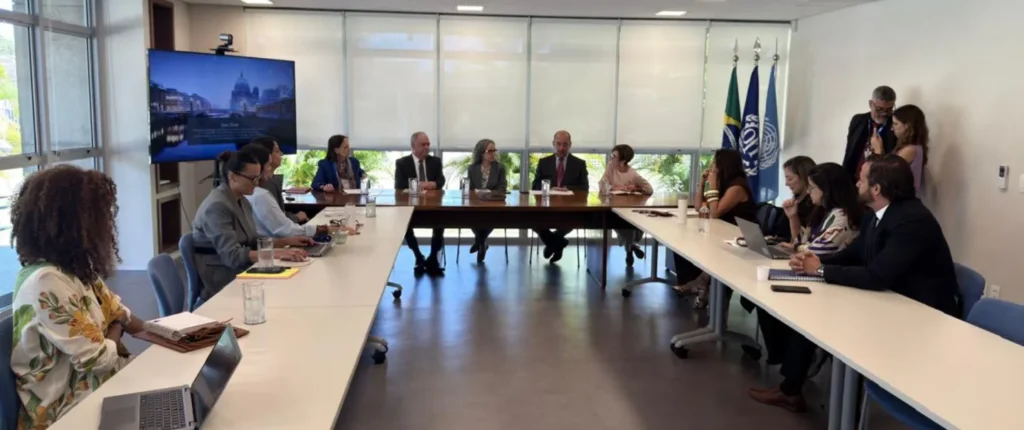
The project agreement was signed in Brasília by Ana Virgínia Moreira Gomes, ILO Regional Director for Latin America and the Caribbean, and Wellington Dias, Brazil’s Minister of Development and Social Assistance, Family and the Fight Against Hunger.
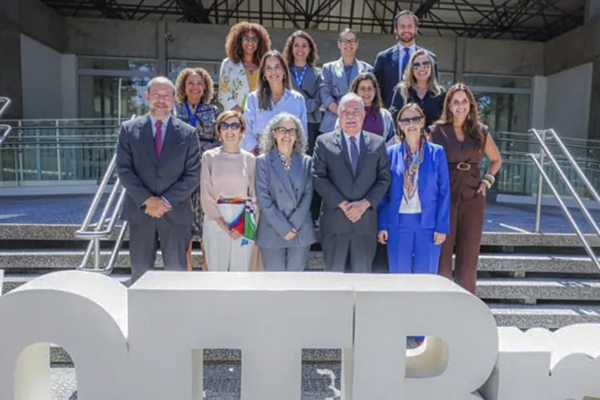
The project was launched in Brasília by Ana Virgínia Moreira Gomes, ILO Regional Director for Latin America and the Caribbean, Osmar Júnior, Brazil’s Acting Minister of Development and Social Assistance, Family and the Fight Against Hunger, and Cecília Malaguti, Head of Trilateral South-South Cooperation at the Brazilian Cooperation Agency (ABC).
“South-South Cooperation is not limited to the exchange of experiences among countries of the Global South. It is also about building a shared regional agenda to promote decent work and social justice for all,” said the ILO Regional Director. “By learning from one another, countries can co-create solutions that respect national contexts while advancing the right to care for all. This is aligns with the Global South4Care platform.”
Acting Minister, Osmar Júnior, noted that international cooperation has been a fundamental pillar for the development and implementation of the Brazilian National Care Policy and Plan.
“This agreement is another important milestone in this regard. It not only reinforces our commitment to the right to care in our country but also enables a rich exchange among countries on care experiences,” he stated. “Together with our partners, we are building collective solutions that will benefit our populations and strengthen our social care policies,” he added.
“The care agenda is a priority for the Government of Brazil. In this context, ABC is currently engaged in advancing the care economy from both a decent work perspective, in partnership with the ILO, and a gender perspective, supporting the territorial implementation of the national care policy while also promoting substantive exchanges with countries of the Global South, in partnership with UN Women,” said Cecília Malaguti.
A horizontal approach to global challenges
The project, titled Care Policies in Latin America: South-South Cooperation, connects Brazil with partner countries in Latin America and the Caribbean facing similar challenges, including ageing populations, high levels of informality and the unequal distribution of unpaid care work.
Recognizing shared structural challenges, the initiative promotes direct knowledge exchange among countries in the region.
The project will be implemented during the 2026-27 biennium and will bring together countries in Latin America and the Caribbean. This project expands on the work already carried out jointly by the two organizations, within the framework of the project “Promoting Social Justice and Gender Equality through Innovative Care Policies”.
Driving change through South-South Cooperation
The initiative builds on Brazil’s recent institutional advances, particularly the National Care Policy (Law No. 15.069/2024), to support regional policy development. It aims to assist partner countries strengthen legal frameworks, governance mechanisms and financing models for care systems. It will also engage development partners and regional institutions to foster knowledge exchange and capacity-building.
The project focuses on four key pillars:
- Identification of countries and/or groups of countries interested in joining the initiative.
- Implementation of country-level projects and South–South cooperation activities in one or more pre-established areas.
- Promotion of regional meetings with countries involved in the project’s thematic areas.
- Systematization of the experiences developed within the project to strengthen capacities for promoting technical cooperation among developing countries.
Beyond borders: A model for the Global South
The project reflects the ILO’s strategy on South-South and Triangular Cooperation, which recognizes the Global South’s capacity to drive innovation in the world of work.
By fostering these exchanges, the programme aims to ensure that lessons learned inform regional and international labour standards. It is expected to generate practical tools and policy guidance that can be adapted in other countries in the Global South.
This partnership highlights the commitment of the Government of Brazil and the ILO to address the care deficit through coordinated and sustainable approaches.
About the Brazil-ILO partnership
Launched in 2009, the Brazil-ILO South-South Cooperation Programme has been a key pillar of international development cooperation for over 15 years. It promotes partnerships across Latin America, Africa and Asia to advance the Decent Work Agenda, social protection and fundamental rights at work.
The current programme cycle (2023–27), titled “Social Justice for the Global South”, focuses on four priority areas: eliminating child labour and forced labour, occupational safety and health, gender and racial equality, and social protection systems.