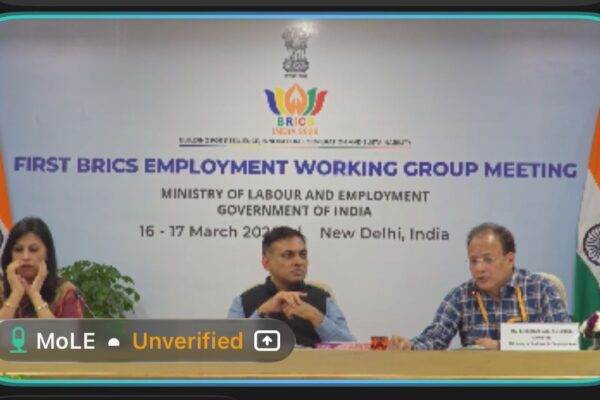
The first meeting of the BRICS Employment Working Group (EWG) under the 2026 Indian Presidency was held virtually on 16–17 March 2026, bringing together representatives from BRICS member states and partner countries—including Brazil, India, Russia, China, South Africa, Indonesia, Egypt, Iran, Ethiopia and the United Arab Emirates—to exchange experiences and advance cooperation on labour and employment policies. The meeting focused on strengthening social protection systems, expanding decent work opportunities, and promoting inclusive labour markets across BRICS economies. In this context, the Indian Presidency placed particular emphasis on advancing social security, skills development, gender inclusion, and the role of digital platforms, supported by ongoing initiatives including an Indian-funded project, South–South Cooperation efforts, and the BRICS virtual Liaison Office.
Opening the meeting, senior officials from India’s Ministry of Labour and Employment emphasized the importance of collective action among BRICS countries to address common labour market challenges. The Indian Presidency highlighted four priority areas for the EWG in 2026: advancing social security and formalization of labour markets; enhancing women’s participation and inclusion in the workforce; cooperation on employability, skills mapping and skills development; and leveraging digital technologies for workers in the unorganized, gig, and platform economy.
During the first day of discussions, participants focused on extending social protection coverage and promoting the formalization of employment. Countries shared national experiences in strengthening social security systems, improving labour market governance, extending coverage to informal workers, and ensuring adequate protection for workers in all types of employment, including temporary, part-time and self-employed workers. Strengthening social protection systems and facilitating access through digitalization and through integrated administrative platforms emerged as key tools to improve access, transparency, and efficiency. Delegations also emphasized the importance of portability of benefits and coordinated policy approaches to support workers moving across sectors, types of employment, and across borders. Under this priority area, the ILO is working in collaboration with the International Social Security Association (ISSA).
The second session of the day examined policies to increase women’s participation and inclusion in the labour market. Discussions highlighted persistent gender gaps in employment, wages, and career opportunities, as well as structural barriers such as unpaid care responsibilities, occupational segregation, job quality and violence and harassment. The potential impacts of AI on women and men’s participation in the labour force were also discussed. The ILO mentioned the South4Care platform – a South-South knowledge exchange platform on care policies to support gender equality at work. Participants presented national initiatives aimed at addressing these challenges, including investments in the care economy, programmes supporting women’s entrepreneurship, expanded maternity protection, and policies promoting women’s access to digital skills and emerging sectors. Under this priority, the ILO is collaborating with the United Nations Resident Coordinator system.
On the second day, the Working Group focused on cooperation in skills development and employability, with particular attention to addressing skills mismatches. Delegations emphasized the need to strengthen global skills intelligence, including better alignment of education and training systems with labour market needs, improved skills mapping, and greater transparency and comparability of skills across countries. They also highlighted the importance of lifelong learning and targeted measures to support youth employment. The ILO, in partnership with the OECD, presented Global Skills Taxonomy and the Skills for Jobs interactive tool to support evidence-based policy making and better transparency of occupations by skills and qualifications requirements. Many country representatives expressed support and readiness to explore joining these efforts.
The final thematic session explored the role of digital technologies in protecting all workers, including gig and platform workers. Countries exchanged experiences on the use of digital platforms for the registration of enterprises and workers, contribution collection and the payment of social protection benefits, and links with skills development, employment services and labour market information systems. Participants underlined the potential of technology to support more inclusive labour markets and universal access to social protection, while noting the importance of appropriate regulatory frameworks to ensure adequate protection for workers in all types of employment, including newly emerging forms of employment. In this area, the ILO is also collaborating with the ISSA.
Across the two days, the discussions emphasized the value of knowledge exchange and South–South cooperation among BRICS countries. Delegations underscored their commitment to continued collaboration in advancing social justice, strengthening labour market institutions, and promoting inclusive and resilient employment systems.
The outcomes of the meeting will inform the ongoing work of the BRICS EWG and contribute to preparations for the BRICS Labour and Employment Ministers’ Meeting later in 2026.